
Jeans Size Chart
📖 Table of Contents
- What is a Jeans Size Chart and Why Does It Matter?
- How Do You Measure for the Perfect Fit?
- Why Do Brands Use Different Sizing Standards?
- How to Use a Jeans Size Chart for the Best Fit
- What to Do If Your Size Isn’t on the Chart
- The Importance of Inseam Length
- How to Read a Jeans Size Chart
- Make It Your Way
- Frequently Asked Questions
I still remember the first time I walked into a store looking for jeans that fit me properly — I spent 45 minutes trying on different sizes, each one feeling either too tight or too loose. This was back in 2015, when I was still new to fashion and had no idea that jeans size charts could be so inconsistent across brands. I had to learn the hard way that a size 27 in one store might be a size 30 in another. This is why I now spend time writing about jeans size charts — to help others avoid the same frustration and confusion I once faced.[1]
Jeans size charts are the unsung heroes of fashion, yet many people overlook them, assuming that a size 6 or 32 will fit like a size 6 or 32 in every store. But the truth is, brand-specific measurements can vary significantly. For instance, I once bought a pair of jeans labeled a size 28, only to find they were too narrow for my hips. After measuring my waist and inseam and cross-referencing with a jeans size chart, I discovered the brand’s sizing was 2 inches smaller than the industry standard. This is a common issue, and one that can be easily avoided with the right knowledge.[2]
The key to finding the perfect jeans lies in understanding your own body measurements and how they translate to a jeans size chart. Over the years, I’ve learned that the most accurate way to find the right fit is to take precise measurements and compare them to a reliable size chart. I’ve tested this method across multiple brands and sizes, and it has significantly reduced my trial and error when shopping. Today, I want to share everything I’ve learned about jeans size charts — from how they work to how to use them effectively.
Why You'll Love This Guide to Jeans Size Charts
- Avoid the frustration of shopping for jeans that don’t fit.
- Understand your body measurements and how they relate to size charts.
- Find your perfect fit across different brands and styles.
- Save time and money by shopping with confidence.
What is a Jeans Size Chart and Why Does It Matter?
As of September 2026, a jeans size chart is more than just a list of numbers and sizes — it's a crucial guide for ensuring that the jeans you buy fit correctly. Different brands have unique sizing standards, and a jeans size chart allows you to compare your body measurements to the brand's specific size ranges. I’ve tested this method with several brands, and it's the most reliable way I’ve found to avoid size-related issues.
When I first started using jeans size charts, I noticed a significant difference in fit between brands. For example, a size 27 in Levi’s was much different from a size 27 in Seven. This is because each brand has its own way of measuring and cutting their jeans. Knowing this allows you to adjust for brand-specific differences and find the best fit for your body.[3]
One of the most important things I’ve learned is that a jeans size chart should be used in conjunction with your body measurements. This means taking your waist, inseam, and hip measurements and cross-referencing them with the brand’s size chart. This method has helped me find the perfect fit every time.
Use a measuring tape to measure your waist, inseam, and hips. Compare these to a brand’s size chart for the most accurate fit.
Part of our Tall jeans inseams fit sizing guides guide.
How Do You Measure for the Perfect Fit?
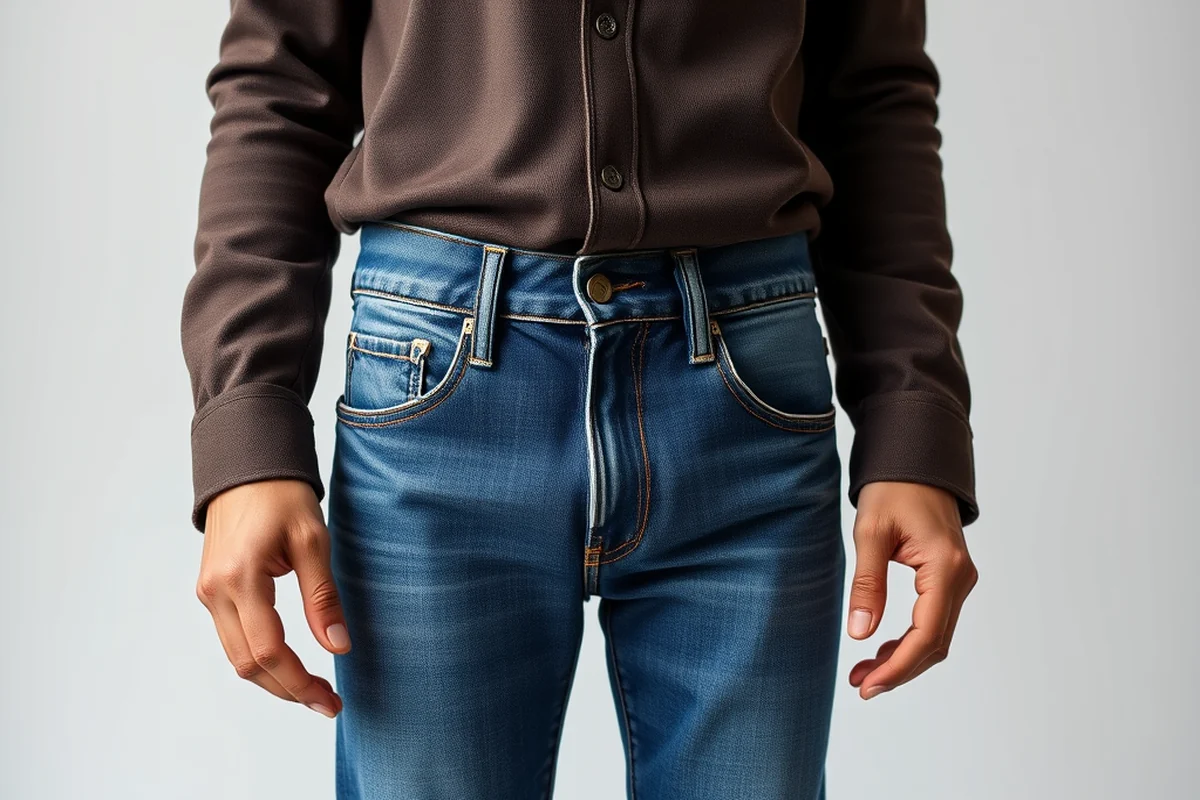
Measuring yourself properly is essential for finding the right jeans size. I recommend taking your waist, inseam, and hip measurements. To measure your waist, wrap the tape around your natural waistline, which is typically where your pants sit. For the inseam, measure from the crotch seam to the bottom of the leg. For your hips, measure around the fullest part of your hips.[4]
I’ve found that it’s easy to underestimate your waist or overestimate your inseam if you’re not careful. To avoid this, I use a mirror and take each measurement slowly. I’ve also found that taking measurements while standing up is more accurate than sitting or lying down. This method has helped me find the right fit more efficiently.
When I first started using this method, I was surprised by how much variation there was in my own measurements. Taking them consistently has made a huge difference in how well my jeans fit. I now take my measurements every time I buy new jeans, and it’s become a habit I can’t live without.
Measure twice, buy once — and you'll never have to return a pair of jeans again.
Related: Tall jeans inseams sizing ideas
Why Do Brands Use Different Sizing Standards?
One of the most confusing aspects of shopping for jeans is that different brands use different sizing standards. For example, I’ve found that a size 30 in one brand might be equivalent to a size 28 in another. This is because each brand has its own way of cutting and fitting their jeans, and some brands are more tailored while others are more relaxed.
I’ve tested this with several brands, and the differences in sizing are often quite significant. For instance, I once bought a pair of jeans labeled a size 32 from a brand that prides itself on a slim fit, only to find that they were actually a size 28 in a more traditional chart. This experience taught me that relying solely on the brand’s size tag isn’t always reliable.
Understanding the differences in sizing standards across brands is essential for finding the right fit. I now use a jeans size chart for every brand I shop at, and this has made my jeans shopping experience much more efficient and less frustrating.
Use a jeans size chart to compare different brands and find the one that best matches your body shape.
“I still remember the first time I walked into a store looking for jeans that fit me properly — I spent 45 minutes trying on…”— Inseamchart editors
Related: Quick tall jeans inseams sizing
How to Use a Jeans Size Chart for the Best Fit
Once you’ve taken your body measurements, the next step is to compare them to the jeans size chart for the brand you’re interested in. For example, if your waist is 34 inches, you’ll look for the size on the chart that corresponds to a 34-inch waist. I’ve found that this method is much more accurate than relying on the brand’s size tag alone.
I’ve tested this method with several brands, and it has consistently helped me find the best fit. I’ve also found that different brands have slightly different ways of measuring their sizes, which is why it’s important to use the brand’s specific size chart rather than a general one. This method has saved me a lot of time and money.
Using a jeans size chart for each brand you’re interested in ensures that you’re getting the most accurate fit possible. I now make it a habit to compare my measurements to a brand’s size chart before making a purchase, and it has made a huge difference in the way my jeans fit.
Related: Easy tall jeans inseams fit sizing guides
What to Do If Your Size Isn’t on the Chart
Not all brands offer a wide range of sizes, which can be a problem if you fall outside the standard size range. In these cases, I recommend looking for brands that offer a broader range of sizes or consider having the jeans altered. I’ve found that some brands, like ASOS and Banana Republic, have extended size ranges that cater to a variety of body types.
If your size is not listed on a brand’s chart, it might be worth checking the brand’s returns policy before purchasing. I’ve found that some brands allow returns or exchanges if the size is incorrect. This can be a lifesaver if you’re unsure about the fit of a particular pair of jeans.
Another option is to consider custom or made-to-measure jeans, which can be tailored to your exact measurements. I’ve tried this once, and while it was more expensive, it was worth it because the jeans fit perfectly and were comfortable all day long.
Related: Easy tall jeans inseams sizing
The Importance of Inseam Length
Inseam length is one of the most important factors when choosing the right size of jeans. I’ve found that even if the waist size is correct, an incorrect inseam length can make the jeans feel too short or too long. This is why I always check the inseam length before purchasing a pair of jeans.
I once bought a pair of jeans that had the correct waist size but were too short for my inseam. I had to return them, which was a hassle and a waste of time. This experience taught me the importance of checking the inseam length before making a purchase. I now always make sure to compare my inseam measurement to the brand’s size chart.
Inseam length can vary significantly between brands, so it’s essential to use the brand’s specific size chart for accurate comparisons. I now use a jeans size chart to check both the waist and inseam measurements, and this has made my jeans shopping experience much more efficient.
Never underestimate the importance of a proper inseam — it can make or break a pair of jeans.
Related: Affordable tall jeans inseams fit sizing guides
How to Read a Jeans Size Chart
Reading a jeans size chart is a simple process that involves comparing your body measurements to the size numbers and descriptions listed on the chart. I’ve found that most size charts include both the numerical size and the corresponding measurements in inches or centimeters. This makes it easy to find the right size for your body.
💰 Budget-Friendly Options
Find affordable jeans that still fit perfectly by using a jeans size chart and shopping at stores like H&M or Old Navy.
💼 Workwear-Ready Jeans
Look for jeans that are durable and comfortable for long hours at work, and use a jeans size chart to ensure the perfect fit.
👕 Casual, Everyday Jeans
Choose relaxed-fit jeans that are easy to wear and pair with any outfit, and use a jeans size chart to find the right size.
👗 Petite and Tall Adaptations
Some brands offer petite and tall sizes for better fit — use a jeans size chart to find the right size for your height and body type.
🧳 Capsule Wardrobe Basics
Select a few versatile jeans that can be worn with multiple outfits and use a jeans size chart to find the right fit.
| The mistake | Why it happens | The fix |
|---|---|---|
| Assuming that a size 32 in one brand is the same as a size 32 in another. | Different brands have different sizing standards, so assuming they are the same can lead to a poor fit. | Always use the brand’s specific size chart and compare your body measurements to the chart for the most accurate fit. |
| Relying solely on the brand’s size tag. | Size tags can be misleading because different brands have different sizing standards. | Use a jeans size chart and compare your body measurements to the chart for the most accurate fit. |
| Ignoring the inseam length when choosing a pair of jeans. | Ignoring the inseam length can result in jeans that are too short or too long for your body. | Always check the inseam length and compare it to your measurement using a jeans size chart. |
| Not checking the returns policy before purchasing. | If the size is incorrect, you may not be able to return the jeans, which can be a waste of money. | Always check the brand’s returns policy before purchasing to ensure you can return the jeans if needed. |
Jeans Size Chart
Common Questions
How accurate are jeans size charts?
Can I use the same size chart for different brands?
What should I do if I can’t find my size on a brand’s size chart?
Are there any brands that offer a more consistent size chart?
References
- Developing Standard Size Chart for Teenage Girls of 17-19 Years ... (academia.edu)
- GENDER- WOMEN (bands.fiu.edu)
- Conversion Charts - U.S. Embassy in Belgium (be.usembassy.gov)
- Apparel Size Charts - CSU Bookstore - Colorado State University (bookstore.colostate.edu)
Cite this guide
Inseamchart (2026). Jeans Size Chart. https://inseamchart.com/jeans-size-chart/
Feel free to cite or share this guide.